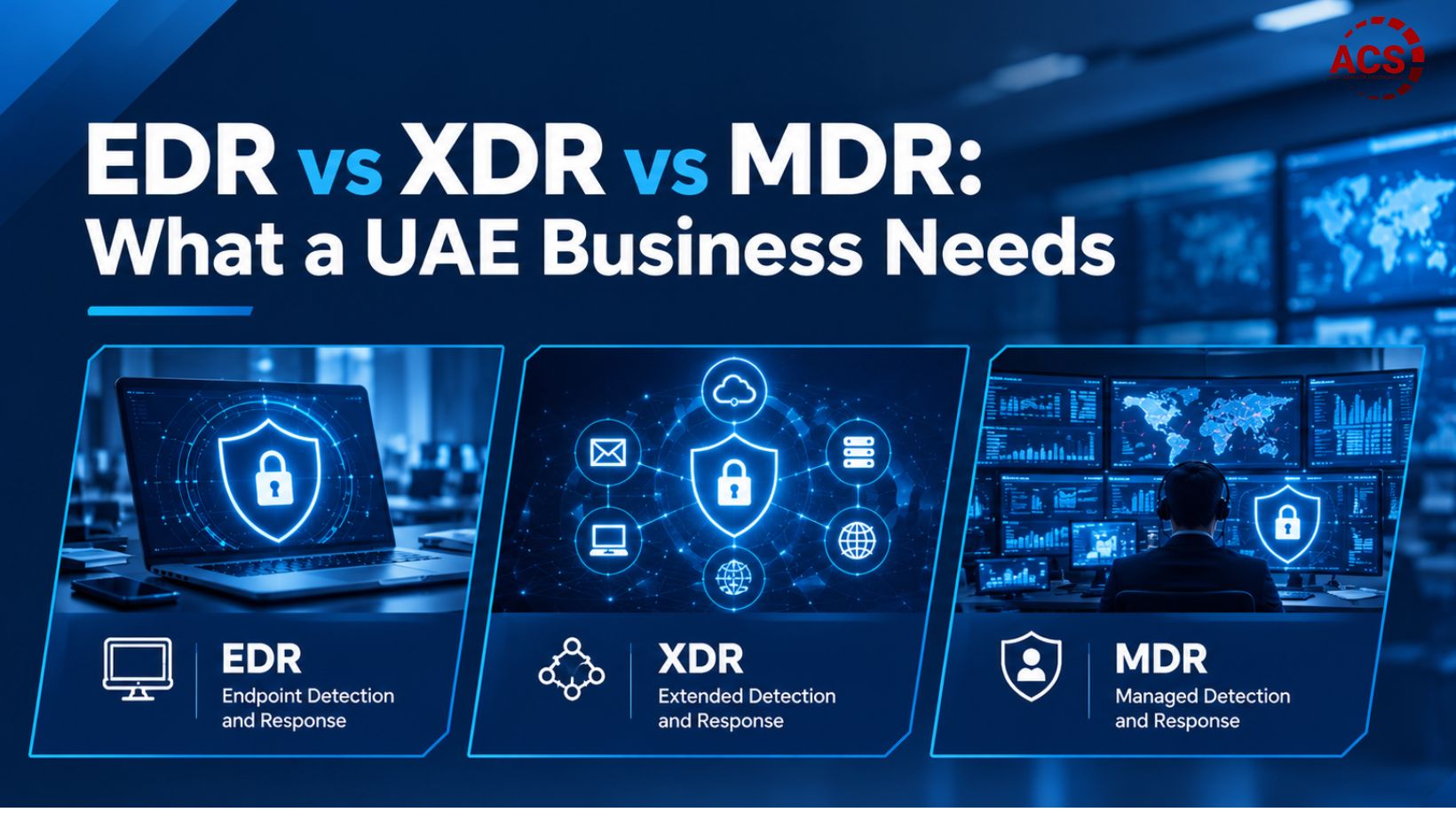
EDR vs XDR vs MDR: What a UAE Business Needs
Introduction
Cybersecurity is essential for businesses across the UAE that depend on digital systems, cloud platforms, and connected devices. Threats such as ransomware, malware, phishing, and unauthorized access can disrupt operations and expose sensitive business information. Choosing the right security solution helps organizations detect suspicious activities and respond to potential incidents more effectively.
EDR solutions UAE, XDR solutions UAE, and MDR services UAE offer different approaches to protecting business environments. Although all three support cybersecurity, they differ in their monitoring scope, detection capabilities, and management requirements. Understanding these differences helps businesses choose suitable protection based on their IT infrastructure, security risks, and available resources.
What Are EDR Solutions?
Endpoint Detection and Response (EDR) is a cybersecurity technology that monitors endpoint devices, including computers, laptops, and servers. It identifies suspicious behavior, records security events, and helps IT teams investigate potential threats.
Businesses searching for EDR solutions in the UAE can use this technology to improve endpoint visibility and detect activities that traditional antivirus software might overlook. EDR tools can help identify malicious processes, suspicious file activity, and possible malware infections.
EDR security UAE solutions are particularly useful for organizations that need greater control over endpoint protection. They can help businesses investigate incidents, identify affected devices, and support appropriate response actions.
What Are XDR Solutions?
Extended Detection and Response (XDR) expands security monitoring beyond individual endpoint devices. It can combine information from multiple integrated sources, including endpoints, networks, email systems, and cloud applications.
XDR solutions in the UAE help security teams connect related alerts and understand suspicious activity across different parts of their IT infrastructure. This broader visibility can make investigations more efficient and help organizations recognize potential attacks earlier.
What Are MDR Services?
Managed Detection and Response (MDR) is a cybersecurity service that combines security technology with specialist monitoring, investigation, and response support. Depending on the agreement, an MDR provider may monitor security alerts, investigate suspicious behavior, and help contain incidents.
MDR services UAE are useful for businesses that lack a dedicated internal security team or need additional cybersecurity expertise. An external provider can help manage security alerts and support incident response without requiring the business to build an entire security operations team.
Managed Detection and Response Dubai services may also offer monitoring outside normal business hours, depending on the provider's service coverage. Businesses should confirm monitoring schedules, response responsibilities, and escalation procedures before selecting a service.
EDR vs XDR vs MDR: Key Differences
EDR focuses mainly on endpoints, XDR connects security information across multiple systems, and MDR provides managed monitoring and response services. Understanding these differences helps businesses identify the approach that best matches their requirements.
1. EDR (Endpoint Detection and Response)
Main Focus: Endpoint protection.
Coverage: Computers, laptops, and servers.
Detection: Identifies endpoint-based threats.
Management: Usually managed by internal IT or security teams.
Best Suited For: Businesses that need endpoint-focused protection.
2. XDR (Extended Detection and Response)
Main Focus: Integrated security visibility.
Coverage: Multiple connected security sources.
Detection: Identifies correlated threats across different systems.
Management: Managed by internal teams or external support providers.
Best Suited For: Businesses that need broader security visibility across their IT infrastructure.
3. MDR (Managed Detection and Response)
Main Focus: Managed threat detection and response.
Coverage: Depends on the service agreement.
Detection: Includes specialist investigation and monitoring.
Management: Managed by third-party security specialists.
Best Suited For: Businesses that need external security expertise for monitoring and responding to threats.
Main Focus: Endpoint protection.
Coverage: Computers, laptops, and servers.
Detection: Identifies endpoint-based threats.
Management: Usually managed by internal IT or security teams.
Best Suited For: Businesses that need endpoint-focused protection.
Main Focus: Integrated security visibility.
Coverage: Multiple connected security sources.
Detection: Identifies correlated threats across different systems.
Management: Managed by internal teams or external support providers.
Best Suited For: Businesses that need broader security visibility across their IT infrastructure.
Main Focus: Managed threat detection and response.
Coverage: Depends on the service agreement.
Detection: Includes specialist investigation and monitoring.
Management: Managed by third-party security specialists.
Best Suited For: Businesses that need external security expertise for monitoring and responding to threats.
These solutions are not necessarily alternatives to one another. Businesses may combine EDR with XDR capabilities or use an MDR provider to manage monitoring and response.
Which Security Solution Does a UAE Business Need?
The right choice depends on the organization's size, infrastructure, security risks, and available expertise. Businesses should assess their endpoint devices, cloud applications, network environment, and ability to investigate security incidents.
Small businesses may begin with EDR solutions in the UAE to strengthen protection for employee computers, laptops, and servers. This approach suits organizations where endpoint security is the top priority and internal IT staff can manage alerts.
Some organizations may need a combination of these approaches. For example, a company can deploy EDR software while working with an MDR provider to investigate alerts and support incident containment.
Important Factors to Consider Before Choosing a Solution
Before selecting EDR security UAE, XDR security Dubai, or managed detection services, businesses should evaluate their existing infrastructure and security requirements. They should determine which devices and applications need protection and whether their security tools can integrate with existing systems.
Incident response capabilities are another important consideration. Businesses should understand whether a solution supports endpoint isolation, threat investigation, incident reporting, and escalation to technical specialists.
Cybersecurity should extend beyond detection technology. Regular software updates, access controls, employee awareness training, secure backups, and incident response planning all contribute to a stronger security strategy.
Why Choose Atop Computer Solutions LLC?
Atop Computer Solutions LLC provides IT and technology solutions for businesses seeking reliable infrastructure and technical support. When evaluating cybersecurity improvements, organizations should consider their current IT environment, endpoint protection needs, monitoring requirements, and incident response capabilities.
Atop Computer Solutions LLC is a strong option when assessing business IT requirements and exploring suitable technology services. Businesses should confirm the availability and scope of specific cybersecurity products and managed detection services before making a purchasing decision.
Conclusion
Choosing between EDR, XDR, and MDR requires an understanding of how each approach supports business cybersecurity. EDR provides endpoint monitoring and response capabilities, XDR connects security information across integrated systems, and MDR delivers managed monitoring, investigation, and response support.
For organizations researching EDR solutions UAE, the decision should reflect their endpoint risks and internal capabilities. Businesses needing broader security visibility may consider XDR solutions UAE, while those requiring specialist monitoring may evaluate MDR services UAE.
Frequently Asked Questions
Q1. What are EDR solutions in the UAE?
EDR solutions monitor endpoint devices to detect suspicious activities, investigate potential threats, and support appropriate security responses.
Q2. What is the difference between EDR and XDR?
EDR focuses primarily on endpoints, while XDR connects security information from multiple integrated sources, potentially including networks, email, and cloud systems.
Q3. What do MDR services in the UAE provide?
MDR services typically include managed threat monitoring, alert investigation, and incident response support. Exact capabilities depend on the provider's agreement.
Q4. Is EDR enough for a small business?
EDR may be sufficient for businesses primarily concerned with endpoint security and equipped to manage alerts. Organizations needing additional expertise may also consider MDR services.
Q5. Should a UAE business choose EDR, XDR, or MDR?
The decision depends on security risks, infrastructure, budget, and internal expertise. EDR focuses on endpoints, XDR provides broader security visibility, and MDR adds managed monitoring and response capabilities.

Leave a comments